Chornobyl was a hyper-event that ruptured Soviet reality, ending the USSR’s cosmo-industrial dream of conquering the cosmos through nuclear power. This essay traces how one disaster reverberates across multiple dimensions – geopolitical, ecological, ontological – asking what it means when the exception becomes the rule.
The accident that took place at the Chornobyl nuclear power plant on 26 April 1986 was not just an event, not merely something that happened. It was a hyper-event. In its confluence of trajectories and flows, a hyper-event delivers an unpredictable manifold of novelty, with reverberations ringing far beyond the scope of its origins, permanently rupturing the ontology of a social order and expanding the circle of affective horizons by which its effects resonate into the world. The hyper-event of Chornobyl implicated us – those who have lived to make sense of it – in the folded fabric of a space-time that has changed as a result of that event. It did this on multiple levels. I will focus on four of them.
Sputnik Modernity and its End
We can think of modernity as a process of serial overcoming by which the old is overtaken by the new: superstition by science, tradition by innovation. In the process, both external and internal limits are broken, with newly opened reserves harnessed for their instrumental value. Nuclear power broke limits in two directions at once: by breaking open the atom (inward), it created an explosive power (outward) that had to be contained lest it destroy worlds. The race to harness its power was part of the race for military superiority, a race whose public face became the race to the moon. For the USSR, a superpower that had renounced religion and tradition, science and technology came to serve as an alternative religion: the ‘sputnik religion’ of physicists and philosophers who dreamt of a cosmos with mankind at its heart – the ‘noosphere’ of human mental life grafted onto the biosphere, in Volodymyr Vernadsky’s terms, extended out to conquer the universe.[1] Nuclear power was to be its engine.
The shadow side of this dream, routinely covered up, included the 1957 Mayak nuclear disaster in Kyshtym (in Russia’s Chelyabinsk region), the third most serious nuclear disaster ever recorded.[2] The Ukrainian city of Prypiat was founded in 1970 to serve as the USSR’s ninth model nuclear city. After Chornobyl’s reactor four exploded, Moscow’s official silence continued for eighteen days, revealing to Soviet citizens what many had long suspected: that their leadership was corrupt and negligent, more obsessed with damage control and nomenklatura privileges than with public safety. In the four years that followed, ecological movements came to embody the first forms of allowable protests that developed into the ‘eco-nationalisms’ that led multiple republics (among them Ukraine) to declare their independence. It was in Chornobyl, then, that the Soviet cosmo-industrial dream met its end.
Cold War Bifurcation Multiplied and Disordered
The Cold War had bifurcated the world into two camps led by superpowers engaged in a risky death dance, a duel of chess-like strategising, mutual secrecy, espionage, and informational warfare. The fall of the USSR may have formally ended the Cold War, but the apparatus for informational warfare remained in place. When one of its mid-level functionaries, Vladimir Putin, ascended to the Russian presidency, he realised its usefulness for shaping global policy: by turning state media like RT (Russia Today) into an international influence network and creating online troll farms like the Internet Research Agency, Putin extended Russia’s informational influence into the newly opened world of global social media.
It was Ukraine that ultimately became the physical battleground. With its pipelines bringing natural gas from Russia to Europe, Ukraine was an essential link in the energy chain that enabled Russia to become a fossil-fuel superpower. And Ukraine’s centrality to Russian imperial historiography, with Kyiv’s role as proverbial ‘cradle’ and ‘mother of Russian cities’, made control over Ukraine a linchpin for Putin’s quest to reconstitute the ‘russkii mir’ and seek Eurasian dominance.
In Ukraine, Chornobyl had been the fulcrum around which national sovereignty was articulated: through the biopolitical apparatus for welfare provisions to ‘Chornobyl sufferers’ (3.5 million) and ‘liquidators’ (another 600,000), the Ukrainian government staked its claim to responsible stewardship of the post-Soviet status quo.[3] Chornobyl became part of a larger narrative of trauma and victimhood that flared up in the post-Maidan period, yet this narrative was constantly challenged by Russian conspiracy theories, disinformation, and ‘false flag operations’: around the Maidan battles, the Russian takeover of Crimea, the June 2014 street battles in Odesa, the downing of Malaysia Airlines Flight 17, and even the relationship between Ukraine, the Bidens, and Donald Trump. That the Epstein files contain over a thousand references to Putin suggests that the files may be the tip of a proverbial iceberg: that Trump and Putin are merely two intertwined vectors of a heretofore untouchable geopolitical elite.
Far from resolving into a unitary liberal-capitalist hegemony (or, Francis Fukuyama’s ‘end of history’), the Cold War bifurcation has multiplied itself endlessly, with every country harbouring echo chambers of the radical right and a reactive liberal left. All this as disinformation entrepreneurs freely serve a newly multipolar information world disorder.
Sacrifice Zones of a Shadow Planet
The Chornobyl exclusion zone came to epitomise another phenomenon: a global network of ‘sacrifice zones’ and ‘shadow places’ that constitute modernity’s ‘underside’ even as they attract a growing cadre of urban explorers and ‘dark tourists’. When the accident occurred, it was Andrei Tarkovsky’s 1979 film Stalker and the novel on which it was based, Arkady and Boris Strugatsky’s Roadside Picnic, that provided the template for interpreting the event. Stalker’s anomalous ‘Zone’ reflected Soviet reality in multiple ways: it was simultaneously the Gulag, the walled-off West, the secluded domain of the nomenklatura, and a zone of past and future war trauma and techno-catastrophe.
The evacuated 30-kilometre exclusion zone around Chornobyl came to be called ‘the Zone’, and unofficial tour guides called themselves ‘stalkers’. When travel to the Zone was legalised, it began attracting up to 20,000 ‘dark tourists’ a year, among them video game enthusiasts of the S.T.A.L.K.E.R. series (Shadow of Chernobyl, Call of Pripyat, and Clear Sky), first-person shooter games ‘in which players battle zombies, mutant animals, and other improbable foes in a hyper-sensationalised contaminated “zone of alienation”’. The abandoned city of Prypiat, once a model nuclear city, became the model post-human city, featuring as a post-apocalypse setting in media projects by the History Channel, National Geographic, and a range of post-nuclear horror films.
Even as it was visited for its post-apocalyptic features, the Zone showed intriguing levels of ecological ‘bounce-back’, with moose, deer, wild boars, wolves, and reintroduced wild Przewalski horses seemingly thriving. The Zone was a zone of presence and absence: the presence of forces unleashed by industrial calamity, the absence of the causes of those forces – the human and industrial activities that precipitated them – except as ruins and odd remainders.[4] A New Safe Confinement structure, meant to keep Chornobyl’s fourth reactor safely contained for another century, was completed in 2017. Yet when the Russian army invaded in early 2022, the entire edifice came close to another disaster.[5] Chornobyl, in all of this, is emblematic of the growing network of ‘ecological sacrifice zones’ at which modernity’s algorithm of global risk becomes tangible and evident on a shadowy Earth.
Anthropocene, or ‘The Zone is Us’
The idea that industrial humanity’s impacts on this planet have been registered geologically has become broadly accepted. Chornobyl’s geological imprint is part of the mid-twentieth century’s ‘Great Acceleration’, with its atom bombs and radioactive isotopes, petrochemicals, and other novel substances rapidly spreading through Earth’s biosphere, hydrosphere, and lithosphere. As Michael Marder writes: ‘Chernobyl’s [sic] 30-km radius is an advanced laboratory, at the leading edge of what is going on with the entire planet. In a consummation of the alienation or self-alienation that has unfortunately proved to be constitutive of the human, the whole world is on its way to becoming Chernobyl or a gulag […]. Entire regions of the world are converted into no-go areas, whether as a consequence of wars or environmental devastation. The effects of climate change leave no place unaffected.’[6]
In this, the Zone is not the 30-kilometre exclusion zone. It is the other way around: the Zone is us, humans transforming the surface of the Earth on a scale that is geological. The Zone is the Holocene, the ‘bubble of reality’ or ‘safety zone’ that has been shaped around human activities for over 12,000 years, which provided the conditions for civilisation and which today is risking total destabilisation. If there is an anomaly here, it is best seen in a mirror.
So we have an event that is multiple things at once: an ‘error’ registering the shadowy underside of industrial modernity; the limit case of a bipolar Cold War order, now transmogrified into a multipolar geo-informational disorder; a cipher of contested narratives including those that would yoke it to Ukraine’s emergent national sovereignty; an emptied yet alluring terrain of the world’s shadow ecology; and a signpost on the accelerometer of the Anthropocene. Forty years in, the hyper-event of Chornobyl remains anomalous – and marks ‘us’ as anomalous.
Endnotes
[1] George M. Young, The Russian Cosmists: The Esoteric Futurism of Nikolai Fedorov and His Followers (Oxford University Press, 2012); Eva Maurer and others, eds., Soviet Space Culture: Cosmic Enthusiasm in Socialist Societies (Palgrave Macmillan, 2011); Mikhail Epstein and Adrian Ivakhiv, ‘Russian Mystical Philosophy’, in The Encyclopedia of Religion and Nature, ed. by B. R. Taylor, vol. 1, 1436-9 (Continuum, 2005); Sonia D. Schmid, Producing Power: The Pre-Chernobyl History of the Soviet Nuclear Industry (MIT Press, 2015).
[2] Boris Komarov (Ze’ev Wolfson), The Destruction of Nature in the Soviet Union, trans. by M. Vale & J. Hollander (M. E. Sharpe, 1980).
[3] Adriana Petryna, Life Exposed: Biological Citizens After Chernobyl (Princeton University Press, 2003); Janice Brummond, ‘Liquidators, Chornobylets and Masonic Ecologists: Ukrainian Environmental Identities’, Oral History, 28.1 (2000), pp. 52–62.
[4] Alan Weisman, The World Without Us (St. Martin’s Press/Picador, 2007); Aftermath: The World After Humans (National Geographic/Cream Productions, Canada, 2008); Life After People (dir. David De Vries, History Channel, USA, 2008); Chernobyl Diaries (dir. Bradley Parker, USA, 2012), Pripyat (dir. Nikolaus Geyrhalter, Czech Republic, 1999); Return of the Living Dead: Necropolis (dir. Ellory Elkayem, USA, 2005); Return of the Living Dead: Rave to the Grave (dir. E. Elkayem, USA, 2005).
[5] See Oleksiy Radynski’s 2023 documentary Chornobyl 22.
[6] Michael Marder, Chernobyl Herbarium: Fragments of an Exploded Consciousness (Open Humanities Press, 2016), p. 54.
Adrian Ivakhiv holds the J. S. Woodsworth Chair in the Humanities at Simon Fraser University, Vancouver, Canada. Until 2024, he was Professor of Environmental Thought and Culture at the University of Vermont, where he co-founded EcoCultureLab. His books include The New Lives of Images: Digital Ecologies and Anthropocene Imaginaries in More-than-Human Worlds (2025), Shadowing the Anthropocene: Eco-Realism for Turbulent Times (2018), Ecologies of the Moving Image: Cinema, Affect, Nature (2013), the anthology Terra Invicta: Ukrainian Wartime Reimaginings for a Habitable Earth (2025), and the co-edited Routledge Handbook of Ecomedia Studies (2023). He also plays and composes music, co-edits the journal Media+Environment, and blogs at Terrestrialism and UKR-TAZ: A Ukrainian Temporary Autonomous Zone.
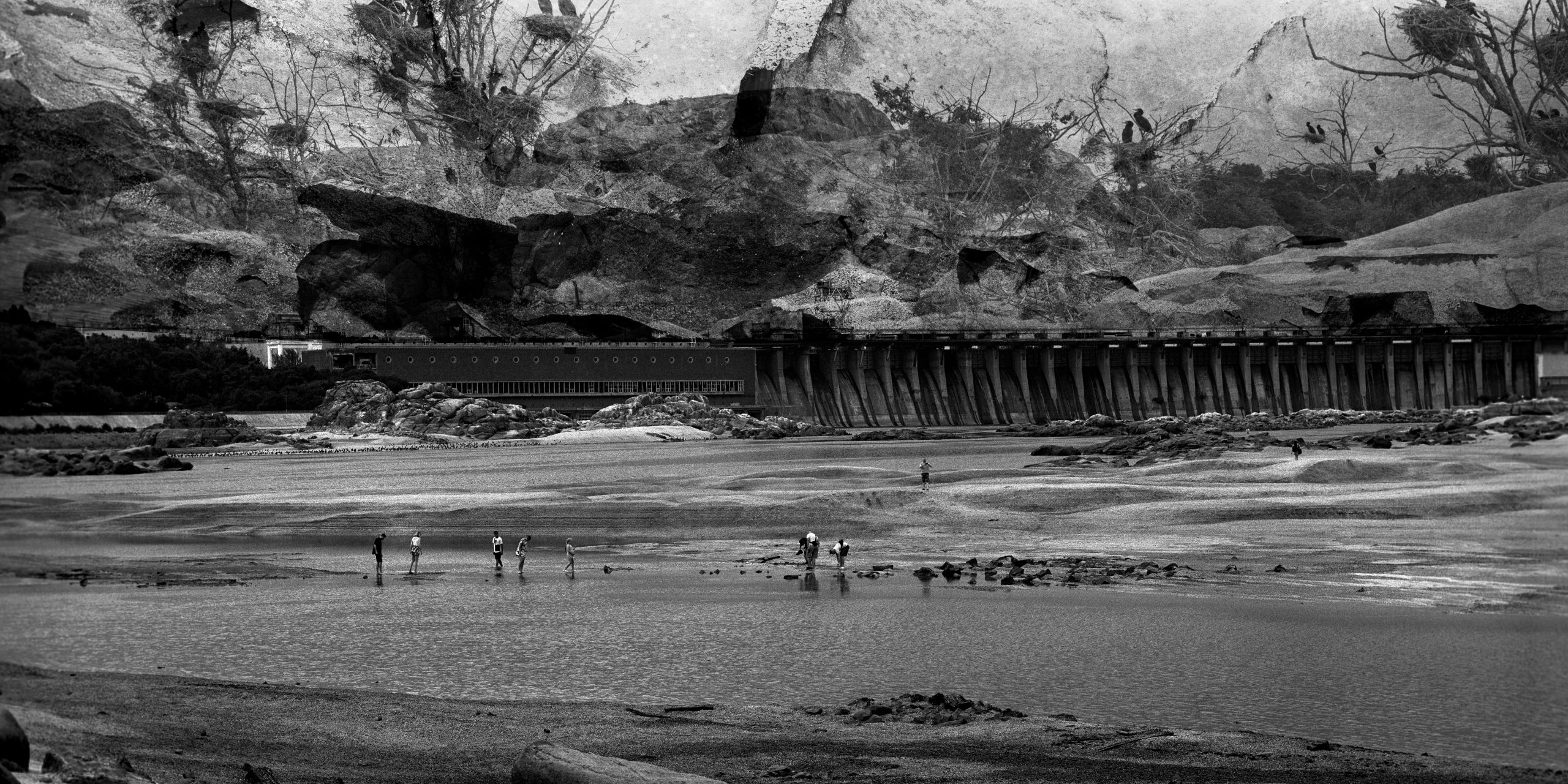
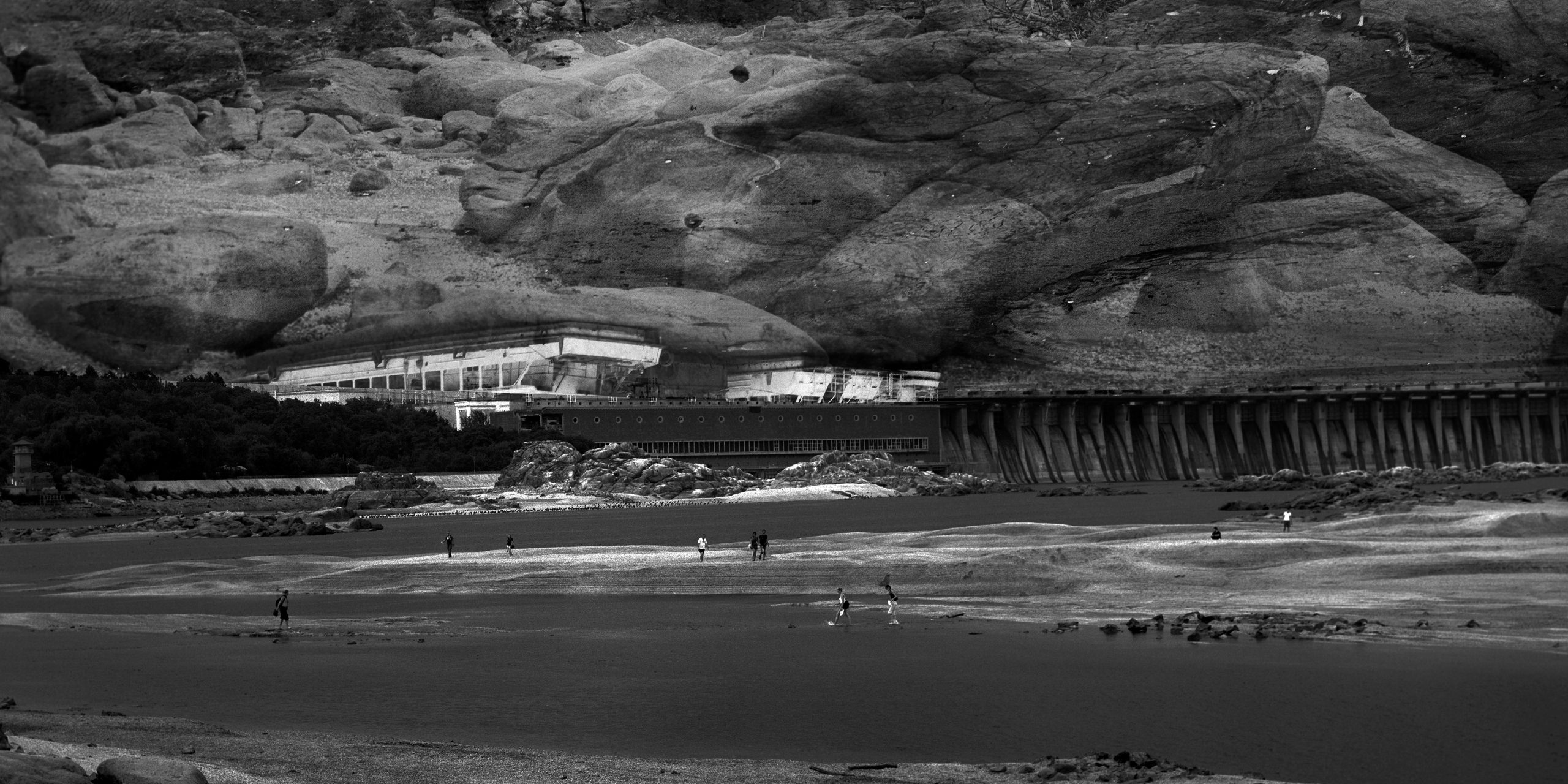
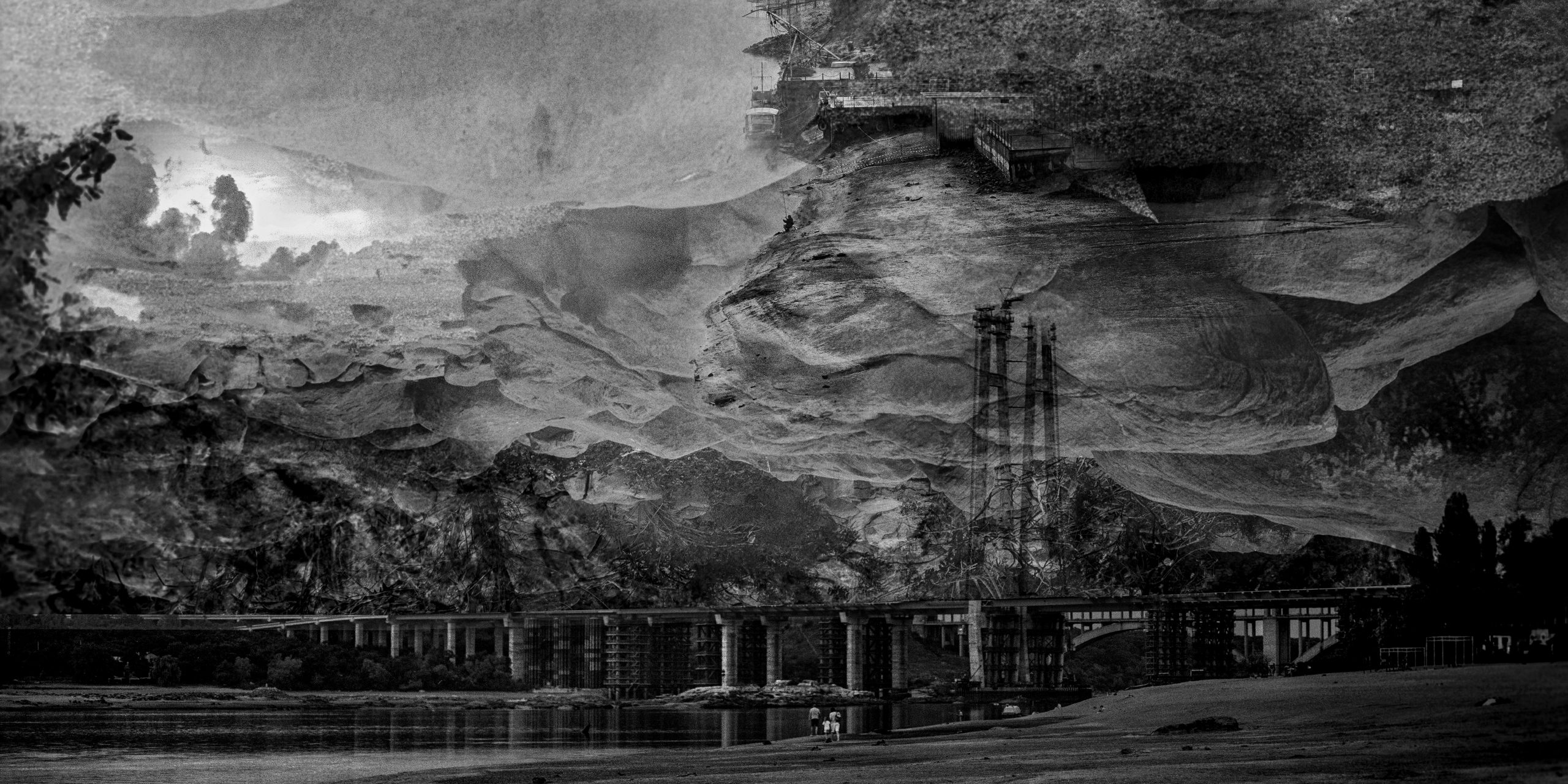
Image: Yana Kononova, Untitled (I) from the series Desperation of Landscape, 2023