The explosion that destroyed the Chornobyl nuclear power plant on 26 April 1986 also reshaped political, ecological, and cultural landscapes around the world. This issue of the London Ukrainian Review marks the fortieth anniversary of the disaster and examines its evolving global impacts.
The Chornobyl nuclear accident spurred mass civic mobilisation across the Soviet republics in the late 1980s, contributing to the USSR’s disintegration in 1991. The Kremlin’s cover-up of the disaster, its disdain for human life in cleaning up the aftermath, and the nuclear fallout that contaminated lands far from the imperial centre fuelled eco-nationalist movements on the peripheries. In Lithuania, protests against the expansion of the Ignalina nuclear power plant (NPP) – which used the same reactor model as Chornobyl (and later became the iconic setting for HBO’s 2019 series) – led the country’s parliament to declare independence in 1990. In Poland, the regime’s opacity about the effects of radiation released by the Chornobyl explosion catalysed environmental protests that hastened the end of Communist rule. In Ukraine, the green movement similarly prompted the civic processes that precipitated the 1991 declaration of independence. Yet, the catastrophe that helped dissolve the Soviet Union did not terminate the cycles of colonial violence emanating from Moscow.
On 14 November 2025, during one of last year’s more than 26,000 Russian drone attacks on Ukraine, an enemy drone struck a residential building in Kyiv, housing families of former Chornobyl nuclear power plant workers. The drone strike burnt down the flat of Nataliia Khodemchuk, the widow of the first victim of the Chornobyl blast, turbine operator Valerii Khodemchuk. Forty years after the catastrophe, the woman died in the fire of the same empire which buried her husband in the ruins of the nuclear power plant. Russia’s full-scale war against Ukraine has unmasked the nuclear dimension of its violence against people and lands that Moscow has sought to subjugate.
Another telling example of mass ruin linking Chornobyl and the full-scale war is discussed by Darya Tsymbalyuk in her recent book, Ecocide in Ukraine (2025). In the 1990s, the village of Vilcha was relocated from the 30-kilometre exclusion zone around Chornobyl to the Kharkiv region. Both sites fell under Russian occupation in 2022. Later that year, both sites were liberated by the Ukrainian army. In 2025, the population of the new Vilcha was reduced to two people as a result of relentless Russian attacks on the Kharkiv region. Deserted cities, uninhabitable terrain, shattered lives: the consequences of Soviet and Russian nuclear policy in Ukraine expose an unmistakable pattern.
The menace of radiation is present in Russia’s invasion of the Chornobyl exclusion zone and takeover of the plant in 2022, the ongoing occupation and weaponisation of the Zaporizhzhia NPP, as well as the Kremlin’s nuclear blackmail, which has influenced the decisions of Ukraine’s international partners. The documentary film Chornobyl 22 shows that, rather than providing easy access to Kyiv, the occupation of the Zone contributed to the offensive’s failure when Russian troops were poisoned by radiation and fuel for Russian tanks was diverted to the NPP’s diesel generators during a power cut. The empire’s refusal to acknowledge the specificity of the territories it claimed ultimately backfired.
This issue of the London Ukrainian Review opens with a conversation with the historian Serhii Plokhy, which reveals the nuclear industry’s structural vulnerabilities. Russia’s seizure of the Zaporizhzhia NPP in March 2022 marks the first time in history that a functioning nuclear power plant has been militarily occupied. However, as Plokhy makes clear, no international legal framework exists to prevent military occupation of nuclear facilities. The conversation questions nuclear energy as a climate solution whilst the industry remains vulnerable to security threats.
Historian Orysia Kulick’s essay excavates the deeper colonial roots of Soviet nuclear power, exposing how the USSR’s ‘nuclear archipelago’ functioned as the Gulag’s twin – a ‘perverse double helix’ exploiting human and environmental resources with little regard for either. Kulick’s closer look at the map of Soviet NPPs foregrounds the punitive function in their geographical distribution: they were ‘disproportionately concentrated in Ukraine (and to a lesser extent Lithuania), lands from which Gulag labour was also disproportionally sourced after WWII’.
Providing an insight into how Chornobyl influenced politics in other countries of the Soviet bloc, Kacper Szulecki explores how the environmental catastrophe led to ‘suprapolitical’ mobilisation in Poland. Citizens learnt of the radioactive cloud from the Soviet NPP disaster through whispered conversations rather than state channels – a betrayal that turned pharmacy queues and playgrounds into political spaces. Szulecki’s argument remains urgent: nuclear infrastructure inherently resists democratic control. These projects operate under permanent emergency conditions, bypassing normal oversight through considerations of national security, technical complexity, and economic necessity. Russia’s use of Ukrainian reactors as instruments of war has exposed the fundamental conflict between nuclear power and democracy.
Yaryna Grusha’s piece explores the impact of Chornobyl on the generation of Ukrainian children from nearby areas that became part of the exclusion zone. Recalling the Soviet cover-up and displacement, medical consequences and trans-generational trauma, the essay shows how the effects of the nuclear disaster were inscribed on individual bodies and families. At the same time, the aftermath of the catastrophe also forged unexpected transnational ties through humanitarian efforts, including for the author, whose life now bridges Ukrainian and Italian culture.
Adrian Ivakhiv, a scholar working at the intersection of environmental and cultural studies, theorises Chornobyl as a ‘hyper-event’ that shattered Soviet reality whilst previewing planetary futures. As the Cold War’s informational warfare metastasises into ‘multipolar information world disorder’, with Ukraine as a key battleground, Ivakhiv argues that ‘the Zone is us’ – not an anomaly, but a concentrated manifestation of humanity transforming the entire planet, making the Anthropocene’s bubble of safety increasingly precarious.
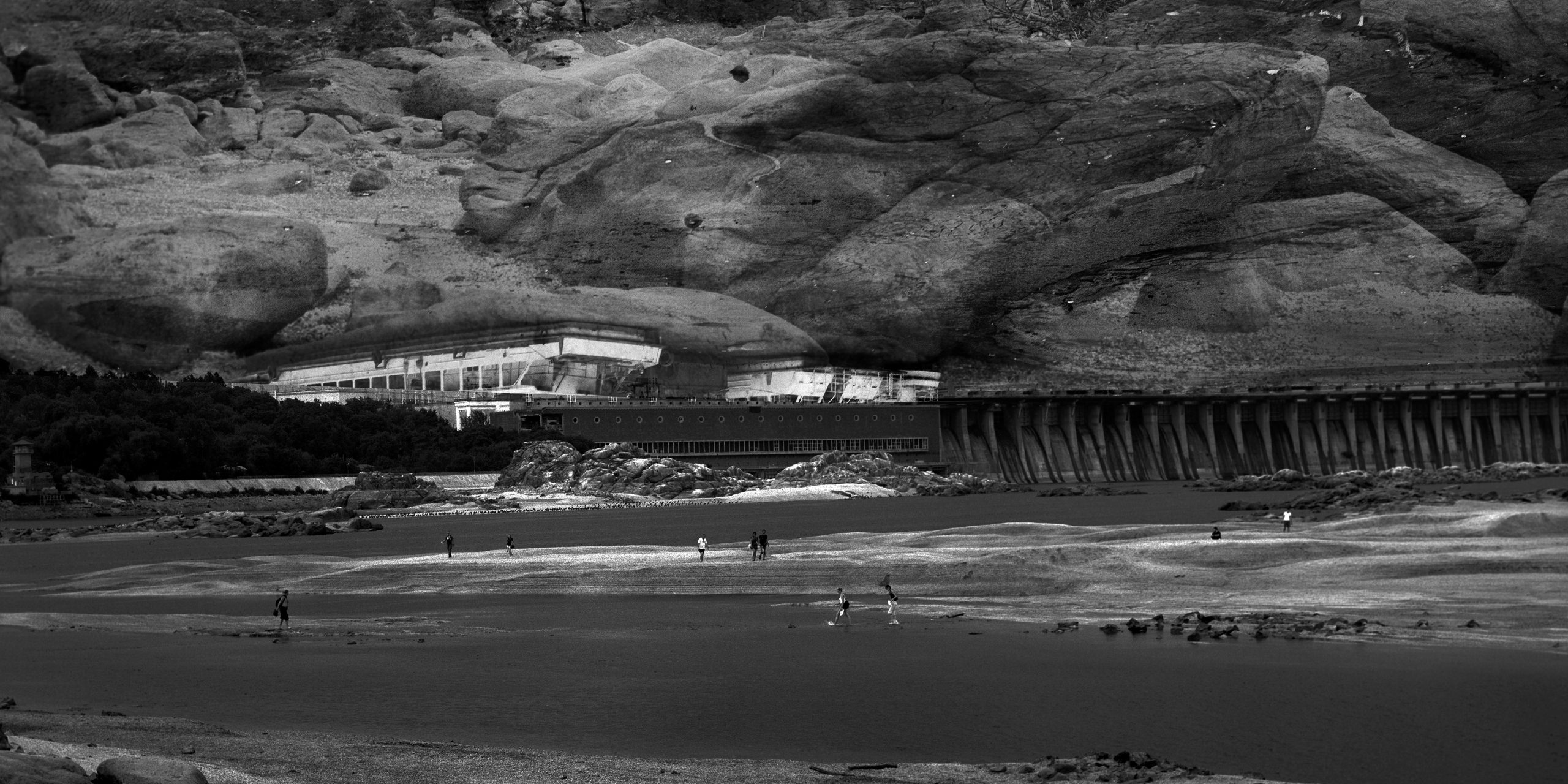
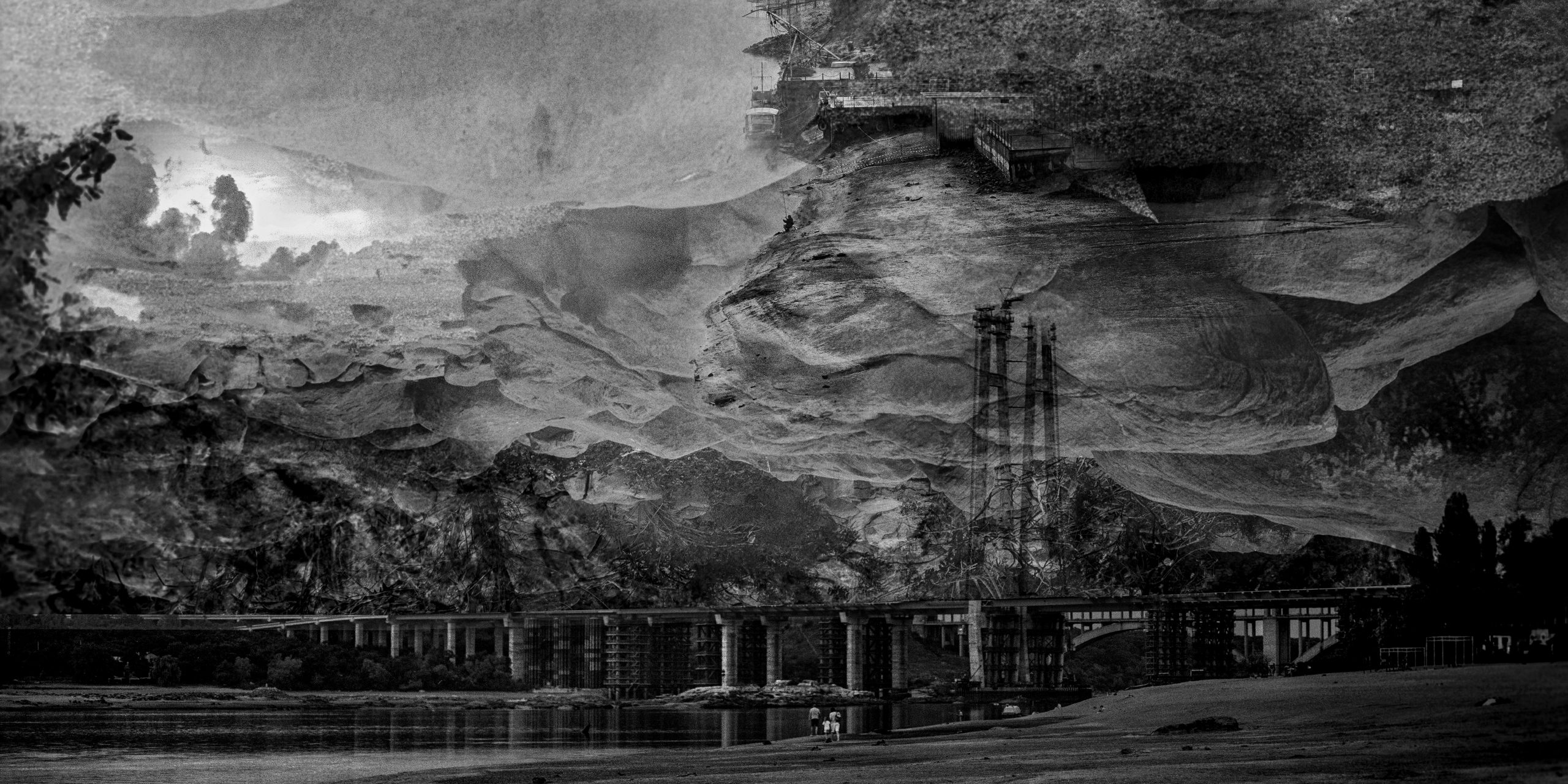
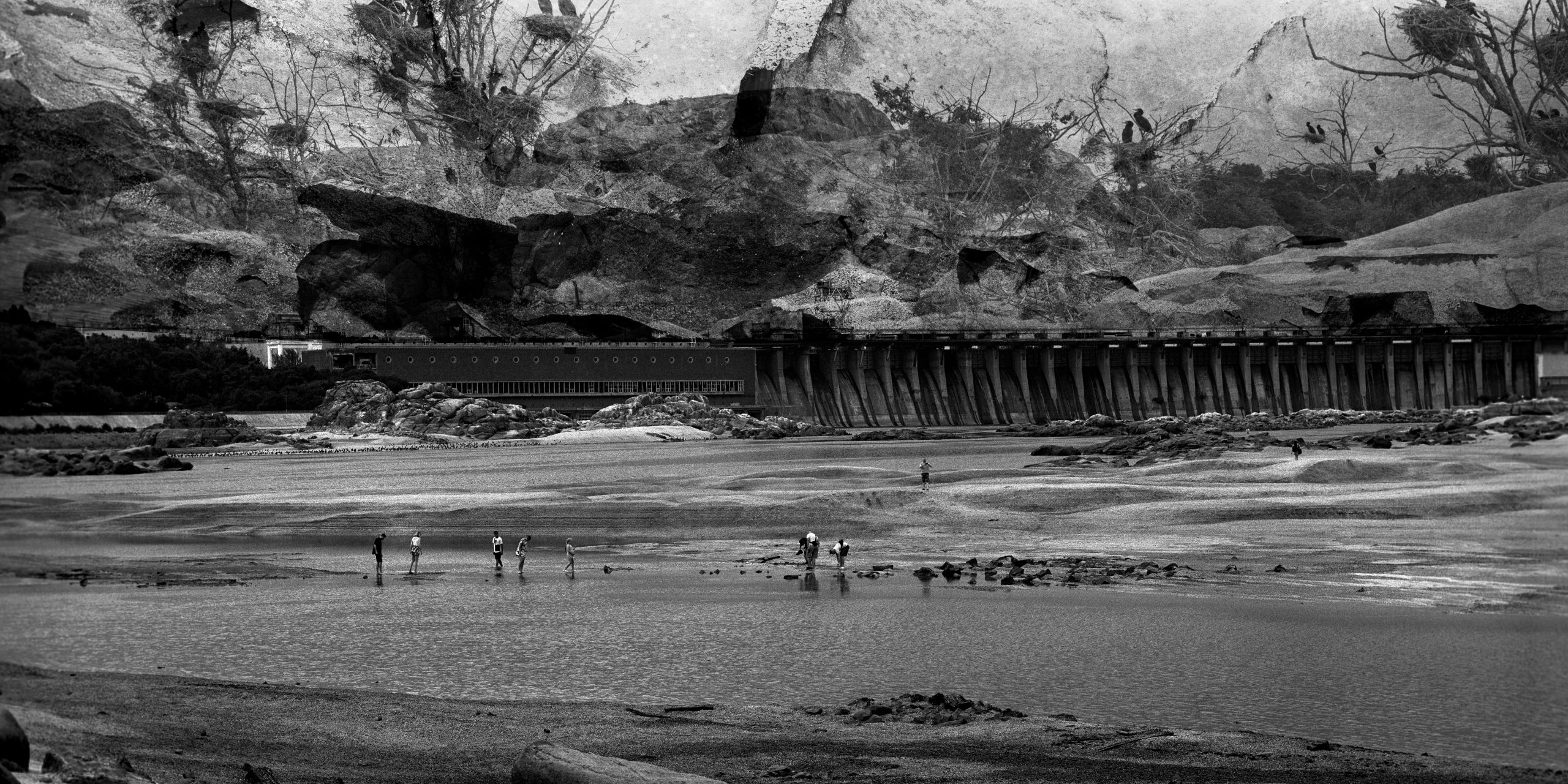
Images from Yana Kononova’s 2023 Desperation of Landscape series, which explores the environmental aftermath of the Russo–Ukrainian war through the combination of documentary photography and collage, form this issue’s visual core. ‘Anchored in the destruction of the Kakhovka Dam, the work follows how landscapes – particularly around Zaporizhzhia, located further upstream – register catastrophe as a slow duration unfolding across geological, industrial, and emotional scales’, the artist explains. ‘Human figures move across newly exposed land or rest on reshaped shores, held in suspension before a world in which desperation emerges as a more-than-human affect, inherent to the landscape itself’.
Across this issue of the London Ukrainian Review, Chornobyl emerges not as a singular catastrophe but as a recurring pattern of nuclear colonialism that concentrates harm in the territories, which, as Orysia Kulick puts it, historically have ‘given the empire nothing but trouble’. The Soviet Union collapsed, yet its techniques persist throughout Russia’s invasion of Ukraine: creating more sacrifice zones. Russia’s nuclear colonialism today lays bare the incompleteness of the reckoning that followed 1986. While the decisions leading to the explosion at the Chornobyl NPP were made in the Kremlin, the USSR’s leaders were never called to account. In the twenty-first century, Moscow’s impunity keeps breeding nuclear monsters, putting the future of the planet at risk.
This issue of the London Ukrainian Review has been published in partnership with the Institute for Human Sciences (IWM Vienna), the Lithuanian Embassy in London, and the Polish Cultural Institute in London, with additional support from Ukrainian Institute London (UIL) Benefactor Madison Floyd.

Sasha Dovzhyk is the Editor-in-chief of the London Ukrainian Review.
Image: Yana Kononova, Pilgrimage (III) from the series Desperation of Landscape, 2023